 English
 عربى
عربى

What Happens When You Put Aluminum Foil in the Microwave (And When It's Actually Safe)
Content
- 1 What Happens Electrically When Foil Meets Microwave Energy
- 2 Can You Put Aluminum Foil in the Microwave Oven? A Direct Answer
- 3 Where Arcing Actually Starts: Common Trigger Points
- 4 A Decision Flow for Using Foil Safely in the Microwave
- 5 Microwave Safe Aluminum Foil Limits by Surface Coverage
- 6 Safe Practices for Heating Food in Foil
- 7 Comparing Packaging Materials Across Storage and Microwave Use
- 8 Selecting Foil for Kitchens, Food Service, and Private Label Packaging
- 9 Frequently Asked Questions
- 9.0.1 Q1: Can you put aluminum foil in the microwave oven at all, even briefly?
- 9.0.2 Q2: Is aluminum foil microwave safe for reheating leftovers wrapped from the refrigerator?
- 9.0.3 Q3: Can aluminum foil spark in microwave ovens even if it never touches the walls?
- 9.0.4 Q4: What are the practical microwave safe aluminum foil limits for coverage area?
- 9.0.5 Q5: Are there safe practices for heating food in foil that apply to commercial kitchens specifically?
What Happens Electrically When Foil Meets Microwave Energy
A microwave oven works by generating electromagnetic energy that excites water molecules inside food, producing heat through friction. Most cookware materials, such as glass or ceramic, allow this energy to pass through and reach the food directly. Aluminum foil behaves in a fundamentally different way because it is a conductive metal. Instead of letting microwave energy pass through, foil reflects it, and free electrons on its surface respond to the oscillating electromagnetic field almost instantly.
This reflective behavior is not automatically dangerous. In fact, foil is routinely used as a shield in commercial food service to slow the cooking of chicken wing tips or pie crust edges. The risk begins when the shape of the foil concentrates electrical charge at a sharp point, a thin edge, or a crumpled fold. When enough charge builds up in a very small area, it can jump through the air toward the oven wall, a metal rack, or another piece of foil, producing a visible spark. This is the mechanism behind the common question of can aluminum foil spark in microwave ovens, and understanding it is the first step toward using foil safely rather than avoiding it out of general caution.
Key distinction: flat, smooth foil reflecting energy away from a small shielded area is generally stable. Crumpled, twisted, or sharply pointed foil concentrates charge and is the primary trigger for visible arcing.
It helps to compare this behavior with how a lightning rod functions on a building. A pointed metal tip does not attract charge out of nowhere, it simply becomes the easiest path for nearby charge to discharge through. Foil in a microwave cavity acts the same way at a smaller scale. A flat surface spreads the reflected field evenly, while a point, a torn corner, or a tight fold gives the field a single narrow location to discharge through, and that discharge is what appears as a spark. Understanding this mechanical explanation turns foil placement into a simple geometry problem that can be checked visually before every use.
Manufacturers of modern microwave ovens are also aware of this behavior, which is why many current appliance manuals now include limited guidance on shielding small food areas with foil rather than issuing a blanket prohibition. This shift in guidance reflects decades of consumer testing showing that the material itself is not inherently incompatible with microwave cooking, only certain shapes and placements of that material.
Can You Put Aluminum Foil in the Microwave Oven? A Direct Answer
The short answer is that can you put aluminum foil in the microwave oven does not have a single yes-or-no response, because the outcome depends entirely on geometry, quantity, and placement rather than the material itself. Small, flat, smoothly applied pieces of foil used to shield a portion of food are generally considered acceptable in most home microwave ovens manufactured in the last two decades, provided the foil never touches the oven's interior walls, door, or ceiling.
On the other hand, wrapping an entire dish tightly in foil, using foil that has been wrinkled into a ball, or microwaving foil trays with sharp crimped edges introduces meaningful risk. So when someone asks can you put aluminum foil in the microwave without qualification, the practical guidance is to treat foil as a conditional tool rather than a forbidden or fully safe material.
The related question, can you microwave aluminum foil on its own with no food underneath, should be answered more cautiously. Bare foil heated alone, without food acting as a partial energy sink, tends to concentrate reflected energy more intensely, which raises the likelihood of arcing even for experienced users.
Another factor is the age and design of the oven itself. Older or lower cost units sometimes have less consistent internal cavity shielding, making them more sensitive to reflective materials near the walls. Newer units, particularly those with rounded corners and evenly distributed waveguides, tend to tolerate small pieces of properly placed foil more reliably, which is why two households can report different results from what looks like an identical piece of foil.
| Scenario | Typical Outcome | Notes |
|---|---|---|
| Small flat foil shield over food edges | Usually stable | Keep at least 2.5 cm from oven walls |
| Crumpled foil ball | High arcing likelihood | Sharp folds concentrate charge |
| Full foil wrap around a dish | Blocks cooking, risk of overheating foil | Energy cannot reach food evenly |
| Foil touching oven wall | High arcing likelihood | Direct proximity to metal cavity |
| Bare foil with no food | Elevated risk | No absorption to dissipate reflected energy |
Ultimately, whether is aluminum foil microwave safe in a given moment comes down to three checkable variables: distance from the cavity walls, the smoothness of the foil's surface, and the proportion of the dish that remains uncovered so energy can still reach the food.
Where Arcing Actually Starts: Common Trigger Points
Across reported home appliance incidents involving metal in microwave ovens, the trigger point is rarely the presence of foil itself but rather one of a small number of recurring geometric conditions. The chart below summarizes the relative frequency of contributing factors observed in consumer appliance safety reviews, expressed as a share of total reported incidents.
The pattern is consistent: geometry and contact points cause the vast majority of incidents, not the mere presence of a smooth, flat sheet of foil at a safe distance. This is why kitchens that use foil intentionally as a partial shield, rather than as an improvised wrapping material, tend to report fewer problems.
It is also worth noting that the severity of an arcing event varies widely. Many incidents amount to nothing more than a brief flash and a faint crackling sound, which stops as soon as the door is opened. A smaller number of cases, typically involving sustained wall contact over a longer cycle, can produce a small flame or scorch the cavity surface. This range explains why some people use foil for years without issue while others hit a problem on a first attempt, and the difference usually traces back to one of the five factors above rather than chance.
A Decision Flow for Using Foil Safely in the Microwave
Before placing any foil in a microwave cavity, running through a short sequence of checks removes most of the guesswork. The flow below outlines the practical decision path used in professional test kitchens.
Microwave Safe Aluminum Foil Limits by Surface Coverage
Home appliance manuals rarely give a numeric threshold, but repeated laboratory testing of consumer microwave ovens gives a useful pattern: the risk of visible arcing rises sharply once foil coverage passes roughly forty percent of a food item's exposed surface, and climbs further as coverage approaches full wrapping. The relationship is not linear at the start, which is part of why small shielding pieces feel deceptively safe even to inexperienced users.
Practical limits derived from this pattern include keeping any single shielded area under roughly one quarter of the dish, avoiding multiple separate foil pieces on the same plate, and never using foil to fully enclose a container that will be run for more than a short shielding interval. These limits apply regardless of foil thickness, since standard household foil and heavier duty foil both fall well within the same conductive range for microwave frequencies; thickness affects tear resistance far more than it affects electrical behavior at this scale.
Safe Practices for Heating Food in Foil
Establishing a short list of habits removes most of the ambiguity around safe practices for heating food in foil at home or in a commercial kitchen setting. The list below reflects the checks used consistently across test kitchens and appliance safety reviews.
- Use foil only to shield small, defined areas such as chicken drumstick tips or the crust edge of a pie, never as a full wrap around an entire plate.
- Press foil flat against the food surface rather than allowing it to stand up or curl away, since raised edges concentrate charge.
- Keep a minimum gap of roughly three centimeters between any foil surface and the oven's interior walls, ceiling, door, and turntable support ring.
- Remove foil trays entirely rather than reheating food directly inside them, and transfer contents to a glass or ceramic dish instead.
- Avoid microwaving twist ties, foil closures, or any packaging component that includes a thin embedded wire.
- Run shorter heating intervals when foil is present, checking the food and the foil's position partway through rather than committing to one long cycle.
- Store leftover foil packaging flat rather than folded into a bundle if there is any chance it will later be reused near a microwave, since a habit of flattening reduces accidental sharp points.
Training staff to recognize these habits works better than memorizing a single rule, since real kitchens present combinations of variables rather than clean textbook examples. A dish might have foil that is flat but too close to the wall, or foil that is far from the wall but folded at one corner. Treating the checklist as cumulative risk factors, rather than a single pass or fail test, gives a more realistic picture of when a small adjustment is worth making.
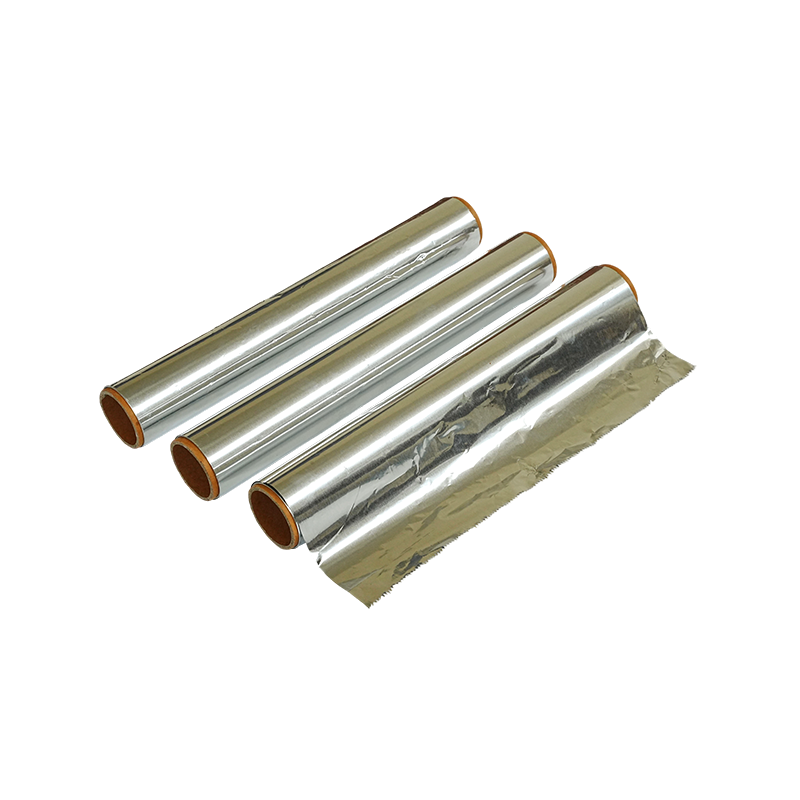
These habits matter more in commercial reheating stations, where high turnover and inconsistent staff training make small mistakes more likely. A kitchen that standardizes on glass or ceramic containers for anything going into a microwave, reserving foil strictly for oven roasting or short shielding tasks, tends to see arcing incidents drop close to zero over time.
Comparing Packaging Materials Across Storage and Microwave Use
Choosing a packaging or wrapping material is rarely about microwave performance alone. Heat resistance, moisture barrier quality, cost efficiency, and recyclability all factor into a kitchen's or a brand's material decision. The radar comparison below places common food-contact materials side by side across five practical dimensions, each scored on a relative scale.
Foil scores highest on heat resistance, moisture barrier, and oxygen barrier, which is precisely why it remains the preferred material for long term storage, freezer wrapping, and oven use. Its lower score for direct microwave use reflects the shielding limits described earlier, not a general weakness of the material. Glass performs well for direct microwave use and recyclability but lacks the lightweight barrier performance that makes foil the standard choice for shipping and shelf storage.
This is why many kitchens use both materials in a complementary rather than competing role. Foil handles tasks where its barrier properties and light weight matter most, including freezer storage, oven roasting, and short term transport, while glass or ceramic handles tasks where direct microwave contact is routine. Treating the two as a paired system, rather than searching for one universal container, tends to produce fewer packaging failures over time.
Selecting Foil for Kitchens, Food Service, and Private Label Packaging
For households, the practical takeaway is straightforward: keep a roll of standard household foil for oven and storage tasks, and default to glass or ceramic for anything reheated in the microwave. For food service operators and packaging buyers, the calculation is broader, since foil is chosen as much for barrier performance and shelf stability as for any single reheating scenario.
Buyers sourcing aluminum foil for food packaging for retail or food service use typically evaluate thickness consistency, tear resistance during high speed wrapping lines, and compliance with food-contact material standards before placing a bulk order. Operations that manage their own branding often look specifically for a private label kitchen aluminum foil roll option, since private label programs allow a consistent roll width, core size, and box format to be matched to existing packaging lines without redesigning equipment.
Where products will come into direct, prolonged contact with food, confirming that a supplier offers certified food grade aluminum foil is a baseline requirement rather than an optional upgrade, since certification affects both regulatory compliance and the alloy purity that determines how the foil performs under heat and folding stress.
Consistency across a full production run matters as much as the specification sheet for a single sample. A roll that measures correctly at the start but drifts in thickness toward the core can cause tearing on automated wrapping lines partway through a shift, creating costly downtime. For this reason, experienced buyers request full-roll samples rather than short cut swatches and test them on their own equipment before committing to a purchase order. Gauge consistency, core hardness, and unwind tension all interact with a specific line in ways a data sheet cannot fully capture, so a short trial run remains the most reliable verification step before scaling to a full order.
Sourcing checklist: confirm food-contact certification, verify consistent gauge across the full roll length, request sample rolls for line compatibility testing, and confirm minimum order quantities align with private label packaging timelines.
Frequently Asked Questions
Q1: Can you put aluminum foil in the microwave oven at all, even briefly?
Yes, in most modern home microwaves a small, flat, smooth piece of foil used to shield part of a dish can be used briefly, as long as it stays well away from the oven walls and does not fully enclose the container.
Q2: Is aluminum foil microwave safe for reheating leftovers wrapped from the refrigerator?
Foil used only to store food in the refrigerator should generally be removed before microwaving, and leftovers should be transferred to a glass or ceramic dish rather than reheated while still wrapped.
Q3: Can aluminum foil spark in microwave ovens even if it never touches the walls?
Yes, sparking can still occur if the foil has sharp folds, torn edges, or points that concentrate charge, even when it is not physically touching any part of the oven cavity.
Q4: What are the practical microwave safe aluminum foil limits for coverage area?
As a general guideline, keep any single foil-shielded area under about one quarter of the dish surface and avoid using more than one separate piece of foil at a time.
Q5: Are there safe practices for heating food in foil that apply to commercial kitchens specifically?
Commercial kitchens benefit from standardizing on glass or ceramic containers for microwave reheating entirely, reserving foil strictly for oven roasting, shielding, and cold storage tasks to reduce staff error.
READY TO CUSTOMIZE YOUR FOIL? CONTACT US TODAY!
+86-13484112116
+86-13967339826
No. 22, Zhijiang Road, Zhouwangmiao Town, Haining City, Jiaxing City, Zhejiang Province, China
Contact Us
